The P-Shot UK uses platelet-rich plasma prepared from your own blood and injected into penile tissue. If you’re considering the P-Shot UK, it’s important to distinguish the proposed mechanism from proven effects. Evidence for PRP as a treatment for Peyronie’s disease remains limited, and good scientific evidence that the P-Shot treats erectile dysfunction is lacking.
This guide explains how the procedure works, who may consider it and what effects have been claimed. It also reviews the evidence on erections, sensitivity and Peyronie’s disease to help you weigh the treatment’s possible role.
A P-Shot UK procedure, also called the Priapus Shot, uses platelet-rich plasma (PRP) prepared from a patient’s blood. PRP is the liquid part of blood, processed to contain a higher concentration of platelets, small blood components involved in clotting and repair signalling.
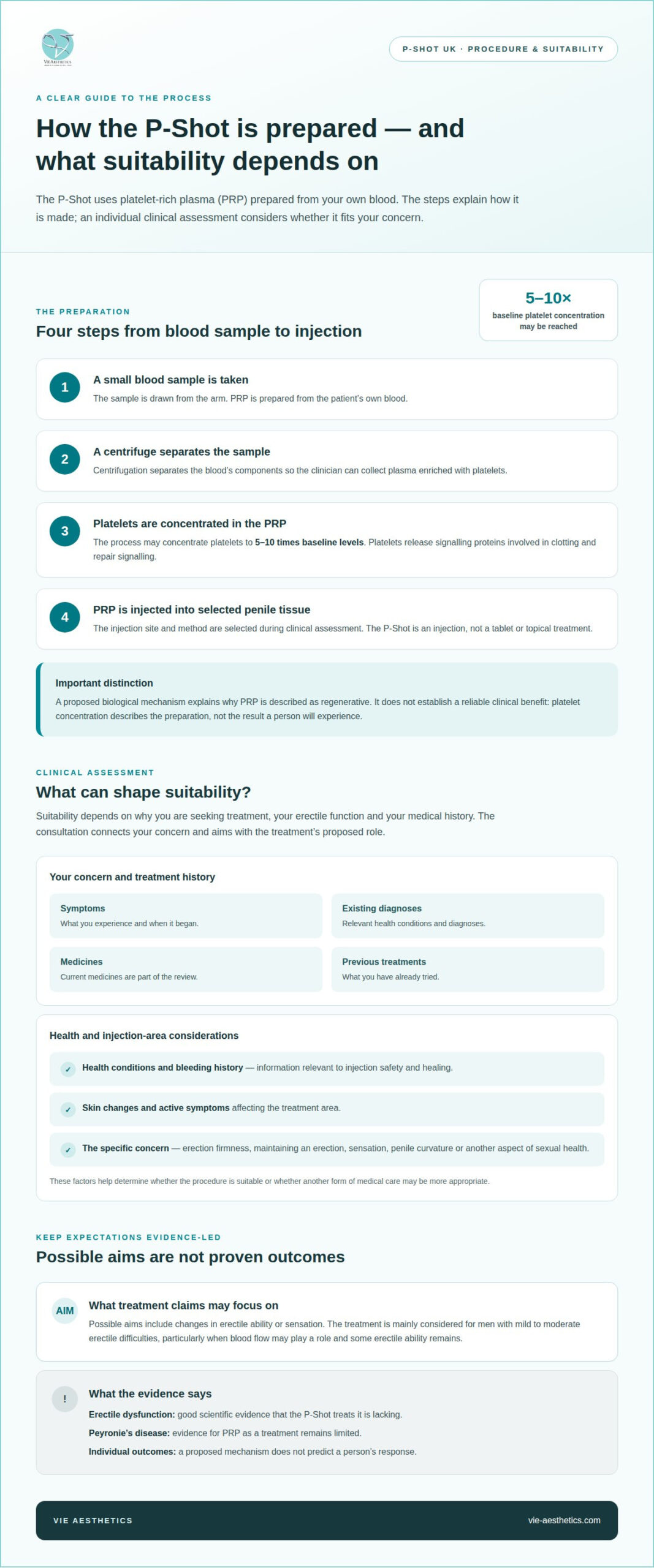
The procedure starts with a small blood sample taken from the arm. A centrifuge separates the sample’s components so the clinician can collect plasma enriched with platelets. The prepared PRP is then injected into selected penile tissue. It is not a tablet or topical treatment.
Centrifugation may concentrate platelets to 5-10 times baseline levels. Platelets release signalling proteins, which are proposed to support the body’s tissue-response processes. This biological rationale explains why the treatment is described as regenerative, but a proposed mechanism doesn’t establish a reliable clinical benefit.
For men considering a P-Shot UK procedure, the injection site and method are selected during clinical assessment, with their concern and medical history informing the discussion. Possible aims may include changes in erectile ability or sensation, but these are treatment aims, not established outcomes. This male treatment differs from vaginal rejuvenation treatment, which addresses female intimate health and different anatomy.
The evidence needs careful interpretation. Good scientific evidence that the P-Shot treats erectile dysfunction is lacking, while evidence for PRP as a treatment for Peyronie’s disease remains limited. A plausible biological process is not proof of an effect: platelet concentration describes the preparation, not the result a person will experience.
Suitability depends on why you’re seeking treatment, your erectile function and your medical history. An assessment can identify relevant health factors and help determine whether the proposed approach fits your concern.
The P-Shot is mainly used for men with mild to moderate erectile dysfunction, particularly when circulation may contribute and some erectile ability remains. These considerations help distinguish someone seeking support for erection quality from someone expecting a change in size or help with a different sexual health concern. The potential role of treatment should match the person’s aims.
A consultation reviews your symptoms, when they began, existing diagnoses, medicines and previous treatments. The clinician can then consider whether the concern relates to erectile function, sensation, penile curvature or another aspect of sexual health. This context matters because similar symptoms can have different causes, and PRP does not address every cause.
Contraindications are factors that make a procedure unsuitable or call for further clinical consideration. An assessment should cover health conditions, medicines, bleeding history, skin changes and any active symptoms affecting the treatment area. These details inform decisions about injection safety and healing, and help identify when another form of medical care may be more appropriate.
Before proceeding, discuss your intended outcome and the limits of the evidence. For example, a man with mild erectile difficulties and some remaining erectile ability may have different considerations from someone with severe dysfunction. A careful consultation connects your history and goals with the treatment’s proposed role, rather than assuming one approach suits everyone.
Possible effects are discussed in relation to erection quality, sensation and circulation. Any proposed benefit depends on the concern being treated and the evidence for that outcome.
Some treatment claims describe improved erectile function or sensitivity after PRP injections. These are possible aims, not results everyone experiences. Claims about sexual performance should be considered in light of the available evidence.
For example, a change in erection firmness is different from a change in sensation or sexual confidence. Keeping these outcomes separate helps clarify what you hope to improve and what the treatment is intended to address.
Blood flow matters because erections depend on circulation within penile tissue. PRP is proposed to support tissue responses, but that mechanism alone does not show that circulation or erectile function will improve after treatment.
Peyronie’s disease involves penile curvature, and evidence for PRP as a treatment remains limited. Curvature and erection quality are separate concerns, so a claimed effect on one does not prove a benefit for the other.
Erectile dysfunction can have different underlying causes, so the pattern of symptoms matters. The P-Shot is mainly used for men with mild to moderate erectile dysfunction, particularly when a vascular component and some erectile ability remain.
That description is not a diagnosis or a prediction of response. Good scientific evidence that the P-Shot treats erectile dysfunction is lacking, so an assessment should distinguish your specific concern from broad claims about plasma, blood flow or function.
For a useful discussion, describe whether your concern involves erection firmness, maintaining an erection, sensation or curvature. These distinctions help clarify the treatment aim and separate potential effects from established outcomes.
Claims about the P-Shot can sound more certain than the evidence supports. Separating the proposed mechanism from proven clinical outcomes helps set realistic expectations.
Reality: Good scientific evidence that the P-Shot treats erectile dysfunction is lacking. The treatment is used mainly for men with mild to moderate erectile difficulties, especially when circulation may contribute and some erectile ability remains. This describes a group considered for treatment, not proof that the injection will improve erections. Erectile dysfunction can have different causes, so a claim about one mechanism cannot establish a benefit for every cause.
Reality: Evidence is lacking that the P-Shot increases penile length or girth. Claims of enlargement should not be treated as established results. The platelet-rich plasma preparation describes what is injected, not a demonstrated increase in size. A proposed tissue-repair process does not, by itself, prove an aesthetic effect or a predictable change in measurements.
Reality: Evidence for PRP as a treatment for Peyronie’s disease remains limited. Penile curvature is a distinct clinical concern, and claims about erectile function do not establish that PRP changes curvature. The treatment should not be presented as a proven way to treat the disease.
Reality: Evidence is lacking for P-Shot effects lasting longer than 1-2 years. Be cautious about claims that present long-term results as certain or universal. A clear explanation distinguishes proposed effects from outcomes supported by evidence, including how long those outcomes have been established.
The P-Shot has a defined procedure and proposed aims, but these are different from established outcomes. Separating what happens during treatment from what someone hopes to experience helps clarify expectations.
The clinician takes a blood sample, processes it to prepare platelet-rich plasma, and injects the plasma into penile tissue. That is the treatment itself. Platelets release signalling proteins involved in the body’s repair processes, providing the biological rationale for using PRP.
The treatment may be considered for a specific concern, such as mild to moderate erectile difficulties when circulation may contribute and some erectile ability remains. The clinician can explain how this aim relates to your health history. The procedure does not produce the same response for everyone.
The P-Shot should not be assumed to improve erections, sensation or sexual performance. Good scientific evidence that it treats erectile dysfunction is lacking, so it should not be described as an established treatment for the condition. Nor does a proposed effect on tissue prove that a particular person’s symptoms will change.
It also cannot be presented as a proven way to increase penile length or girth, treat Peyronie’s disease, or address every cause of erectile difficulties. Evidence for PRP in Peyronie’s disease remains limited, and evidence for size increases is lacking. These distinctions matter: a treatment’s proposed mechanism is not proof of each claimed benefit.
In practical terms, the P-Shot delivers an injection of your own processed plasma. It does not replace a clear assessment of your concern, the evidence for the intended outcome or a discussion of other treatment options. A sound decision matches the treatment aim to your circumstances.
Evidence for PRP as a treatment for Peyronie’s disease remains limited. The P-Shot should not be presented as a proven treatment for penile curvature.
For erectile dysfunction, the options differ in evidence and approach:
| Treatment | What is known |
|---|---|
| P-Shot | Good scientific evidence that it treats erectile dysfunction is lacking. |
| PDE-5 medicines, such as sildenafil or tadalafil | These are first-line erectile dysfunction treatments with robust evidence and regulatory approval. |
A typical P-Shot procedure takes approximately 40 minutes. The clinician prepares platelet-rich plasma from a blood sample and injects it into penile tissue.
Swelling or bruising may occur for up to 48 hours. Normal activities can resume immediately, although aftercare advice may include avoiding exercise for up to five days.
The P-Shot is offered by private clinics in the UK. The NHS does not provide or fund this treatment. Its price depends on the case and is provided after a quote request; relevant factors include the consultation, preparation and procedure.
When assessing a clinic, note the practitioner’s full name and professional registration details. For a doctor, use their name to check registration with the General Medical Council.
A P-Shot appointment includes discussion of your concerns and health history, followed by preparation and treatment when appropriate. The procedure takes approximately 40 minutes; consultation and preparation may affect the total appointment time.
Some clinics offer consultations lasting 60-90 minutes versus a standard 30 minutes; Birmingham appointments take approximately 60 minutes. Sessions take less than 30-45 minutes; repeat after 4-6 weeks.
Vie Aesthetics offers the P-Shot (Priapus Shot) at its doctor-led, multi-award-winning, CQC-registered clinic. If you’re considering PRP treatment for male intimate health, a no-obligation consultation can help you discuss your concerns and whether the treatment may fit your goals.
The consultation is a space to discuss what you hope to address, such as erectile function or sensation, and share relevant health information. You can also ask about the procedure, aftercare and evidence for the outcomes you’re considering. This personalised discussion helps keep expectations grounded in the available evidence rather than broad claims about results.
It’s important to distinguish treatment aims from established benefits. Good scientific evidence that the P-Shot treats erectile dysfunction is lacking, and evidence for PRP as a treatment for Peyronie’s disease remains limited. A discussion can explore these limits, particularly if your main concern is penile curvature or sexual performance.
Consultations are no-obligation. All prices are subject to change. You can take time to consider the information before deciding whether to proceed.
To arrange a conversation at your own pace, choose the option that feels most comfortable:
The clinician prepares platelet-rich plasma from a blood sample and injects it into penile tissue. A typical sample is about 10 ml, taken from the arm, then processed in a centrifuge to separate plasma. Platelets are concentrated during this step. The clinician discusses the procedure and intended treatment area before proceeding, so the approach reflects the patient’s concern rather than a standardised injection plan.
Initial effects may appear within 2-4 weeks, with peak results reported at 8-12 weeks. These timeframes describe reported patterns, not a schedule that applies to every person. For example, changes in erection quality may be noticed at a different point from changes in sensation. Keep track of the specific outcome you hoped to address, then discuss it during any follow-up.
Temporary swelling, bruising or sensitivity may occur after the injections and can last up to 48 hours. Contact a healthcare professional if pain worsens or continues beyond a few days. Numbness lasting more than a few hours also warrants medical advice. These symptoms are distinct from expected short-lived tenderness, so note when they began and whether they are improving.
Topical local anaesthetic is applied to the skin before the injections to reduce sensation, but it does not make the area completely sensation-free. People experience treatment differently. Tell the clinician about any discomfort during the appointment so they can respond appropriately and explain what sensations to expect during the procedure.
You may resume normal activities immediately after treatment, and sexual intercourse may be possible the same day. Exercise advice differs: patients may be advised to avoid it for up to five days. Follow the aftercare guidance provided, especially if swelling or bruising occurs. Resuming everyday activities and returning to exercise are separate decisions.
The P-Shot, or Priapus Shot, injects platelet-rich plasma, commonly shortened to PRP, into penile tissue. PRP is prepared from the patient’s own blood and contains concentrated platelets. The name describes the treatment, not a separate medicine or implant. Its proposed uses include intimate health concerns, but the evidence for specific outcomes varies by condition.

The P-Shot UK uses platelet-rich plasma prepared from your own blood and injected into penile tissue. If you’re considering the P-Shot UK, it’s important to distinguish the proposed mechanism from proven effects. Evidence for PRP as a treatment for Peyronie’s disease remains limited, and good scientific evidence that the P-Shot treats erectile dysfunction is lacking.
This guide explains how the procedure works, who may consider it and what effects have been claimed. It also reviews the evidence on erections, sensitivity and Peyronie’s disease to help you weigh the treatment’s possible role.
A P-Shot UK procedure, also called the Priapus Shot, uses platelet-rich plasma (PRP) prepared from a patient’s blood. PRP is the liquid part of blood, processed to contain a higher concentration of platelets, small blood components involved in clotting and repair signalling.
The procedure starts with a small blood sample taken from the arm. A centrifuge separates the sample’s components so the clinician can collect plasma enriched with platelets. The prepared PRP is then injected into selected penile tissue. It is not a tablet or topical treatment.
Centrifugation may concentrate platelets to 5-10 times baseline levels. Platelets release signalling proteins, which are proposed to support the body’s tissue-response processes. This biological rationale explains why the treatment is described as regenerative, but a proposed mechanism doesn’t establish a reliable clinical benefit.
For men considering a P-Shot UK procedure, the injection site and method are selected during clinical assessment, with their concern and medical history informing the discussion. Possible aims may include changes in erectile ability or sensation, but these are treatment aims, not established outcomes. This male treatment differs from vaginal rejuvenation treatment, which addresses female intimate health and different anatomy.
The evidence needs careful interpretation. Good scientific evidence that the P-Shot treats erectile dysfunction is lacking, while evidence for PRP as a treatment for Peyronie’s disease remains limited. A plausible biological process is not proof of an effect: platelet concentration describes the preparation, not the result a person will experience.
Suitability depends on why you’re seeking treatment, your erectile function and your medical history. An assessment can identify relevant health factors and help determine whether the proposed approach fits your concern.
The P-Shot is mainly used for men with mild to moderate erectile dysfunction, particularly when circulation may contribute and some erectile ability remains. These considerations help distinguish someone seeking support for erection quality from someone expecting a change in size or help with a different sexual health concern. The potential role of treatment should match the person’s aims.
A consultation reviews your symptoms, when they began, existing diagnoses, medicines and previous treatments. The clinician can then consider whether the concern relates to erectile function, sensation, penile curvature or another aspect of sexual health. This context matters because similar symptoms can have different causes, and PRP does not address every cause.
Contraindications are factors that make a procedure unsuitable or call for further clinical consideration. An assessment should cover health conditions, medicines, bleeding history, skin changes and any active symptoms affecting the treatment area. These details inform decisions about injection safety and healing, and help identify when another form of medical care may be more appropriate.
Before proceeding, discuss your intended outcome and the limits of the evidence. For example, a man with mild erectile difficulties and some remaining erectile ability may have different considerations from someone with severe dysfunction. A careful consultation connects your history and goals with the treatment’s proposed role, rather than assuming one approach suits everyone.
Possible effects are discussed in relation to erection quality, sensation and circulation. Any proposed benefit depends on the concern being treated and the evidence for that outcome.
Some treatment claims describe improved erectile function or sensitivity after PRP injections. These are possible aims, not results everyone experiences. Claims about sexual performance should be considered in light of the available evidence.
For example, a change in erection firmness is different from a change in sensation or sexual confidence. Keeping these outcomes separate helps clarify what you hope to improve and what the treatment is intended to address.
Blood flow matters because erections depend on circulation within penile tissue. PRP is proposed to support tissue responses, but that mechanism alone does not show that circulation or erectile function will improve after treatment.
Peyronie’s disease involves penile curvature, and evidence for PRP as a treatment remains limited. Curvature and erection quality are separate concerns, so a claimed effect on one does not prove a benefit for the other.
Erectile dysfunction can have different underlying causes, so the pattern of symptoms matters. The P-Shot is mainly used for men with mild to moderate erectile dysfunction, particularly when a vascular component and some erectile ability remain.
That description is not a diagnosis or a prediction of response. Good scientific evidence that the P-Shot treats erectile dysfunction is lacking, so an assessment should distinguish your specific concern from broad claims about plasma, blood flow or function.
For a useful discussion, describe whether your concern involves erection firmness, maintaining an erection, sensation or curvature. These distinctions help clarify the treatment aim and separate potential effects from established outcomes.
Claims about the P-Shot can sound more certain than the evidence supports. Separating the proposed mechanism from proven clinical outcomes helps set realistic expectations.
Reality: Good scientific evidence that the P-Shot treats erectile dysfunction is lacking. The treatment is used mainly for men with mild to moderate erectile difficulties, especially when circulation may contribute and some erectile ability remains. This describes a group considered for treatment, not proof that the injection will improve erections. Erectile dysfunction can have different causes, so a claim about one mechanism cannot establish a benefit for every cause.
Reality: Evidence is lacking that the P-Shot increases penile length or girth. Claims of enlargement should not be treated as established results. The platelet-rich plasma preparation describes what is injected, not a demonstrated increase in size. A proposed tissue-repair process does not, by itself, prove an aesthetic effect or a predictable change in measurements.
Reality: Evidence for PRP as a treatment for Peyronie’s disease remains limited. Penile curvature is a distinct clinical concern, and claims about erectile function do not establish that PRP changes curvature. The treatment should not be presented as a proven way to treat the disease.
Reality: Evidence is lacking for P-Shot effects lasting longer than 1-2 years. Be cautious about claims that present long-term results as certain or universal. A clear explanation distinguishes proposed effects from outcomes supported by evidence, including how long those outcomes have been established.
The P-Shot has a defined procedure and proposed aims, but these are different from established outcomes. Separating what happens during treatment from what someone hopes to experience helps clarify expectations.
The clinician takes a blood sample, processes it to prepare platelet-rich plasma, and injects the plasma into penile tissue. That is the treatment itself. Platelets release signalling proteins involved in the body’s repair processes, providing the biological rationale for using PRP.
The treatment may be considered for a specific concern, such as mild to moderate erectile difficulties when circulation may contribute and some erectile ability remains. The clinician can explain how this aim relates to your health history. The procedure does not produce the same response for everyone.
The P-Shot should not be assumed to improve erections, sensation or sexual performance. Good scientific evidence that it treats erectile dysfunction is lacking, so it should not be described as an established treatment for the condition. Nor does a proposed effect on tissue prove that a particular person’s symptoms will change.
It also cannot be presented as a proven way to increase penile length or girth, treat Peyronie’s disease, or address every cause of erectile difficulties. Evidence for PRP in Peyronie’s disease remains limited, and evidence for size increases is lacking. These distinctions matter: a treatment’s proposed mechanism is not proof of each claimed benefit.
In practical terms, the P-Shot delivers an injection of your own processed plasma. It does not replace a clear assessment of your concern, the evidence for the intended outcome or a discussion of other treatment options. A sound decision matches the treatment aim to your circumstances.
Evidence for PRP as a treatment for Peyronie’s disease remains limited. The P-Shot should not be presented as a proven treatment for penile curvature.
For erectile dysfunction, the options differ in evidence and approach:
| Treatment | What is known |
|---|---|
| P-Shot | Good scientific evidence that it treats erectile dysfunction is lacking. |
| PDE-5 medicines, such as sildenafil or tadalafil | These are first-line erectile dysfunction treatments with robust evidence and regulatory approval. |
A typical P-Shot procedure takes approximately 40 minutes. The clinician prepares platelet-rich plasma from a blood sample and injects it into penile tissue.
Swelling or bruising may occur for up to 48 hours. Normal activities can resume immediately, although aftercare advice may include avoiding exercise for up to five days.
The P-Shot is offered by private clinics in the UK. The NHS does not provide or fund this treatment. Its price depends on the case and is provided after a quote request; relevant factors include the consultation, preparation and procedure.
When assessing a clinic, note the practitioner’s full name and professional registration details. For a doctor, use their name to check registration with the General Medical Council.
A P-Shot appointment includes discussion of your concerns and health history, followed by preparation and treatment when appropriate. The procedure takes approximately 40 minutes; consultation and preparation may affect the total appointment time.
Some clinics offer consultations lasting 60-90 minutes versus a standard 30 minutes; Birmingham appointments take approximately 60 minutes. Sessions take less than 30-45 minutes; repeat after 4-6 weeks.
Vie Aesthetics offers the P-Shot (Priapus Shot) at its doctor-led, multi-award-winning, CQC-registered clinic. If you’re considering PRP treatment for male intimate health, a no-obligation consultation can help you discuss your concerns and whether the treatment may fit your goals.
The consultation is a space to discuss what you hope to address, such as erectile function or sensation, and share relevant health information. You can also ask about the procedure, aftercare and evidence for the outcomes you’re considering. This personalised discussion helps keep expectations grounded in the available evidence rather than broad claims about results.
It’s important to distinguish treatment aims from established benefits. Good scientific evidence that the P-Shot treats erectile dysfunction is lacking, and evidence for PRP as a treatment for Peyronie’s disease remains limited. A discussion can explore these limits, particularly if your main concern is penile curvature or sexual performance.
Consultations are no-obligation. All prices are subject to change. You can take time to consider the information before deciding whether to proceed.
To arrange a conversation at your own pace, choose the option that feels most comfortable:
The clinician prepares platelet-rich plasma from a blood sample and injects it into penile tissue. A typical sample is about 10 ml, taken from the arm, then processed in a centrifuge to separate plasma. Platelets are concentrated during this step. The clinician discusses the procedure and intended treatment area before proceeding, so the approach reflects the patient’s concern rather than a standardised injection plan.
Initial effects may appear within 2-4 weeks, with peak results reported at 8-12 weeks. These timeframes describe reported patterns, not a schedule that applies to every person. For example, changes in erection quality may be noticed at a different point from changes in sensation. Keep track of the specific outcome you hoped to address, then discuss it during any follow-up.
Temporary swelling, bruising or sensitivity may occur after the injections and can last up to 48 hours. Contact a healthcare professional if pain worsens or continues beyond a few days. Numbness lasting more than a few hours also warrants medical advice. These symptoms are distinct from expected short-lived tenderness, so note when they began and whether they are improving.
Topical local anaesthetic is applied to the skin before the injections to reduce sensation, but it does not make the area completely sensation-free. People experience treatment differently. Tell the clinician about any discomfort during the appointment so they can respond appropriately and explain what sensations to expect during the procedure.
You may resume normal activities immediately after treatment, and sexual intercourse may be possible the same day. Exercise advice differs: patients may be advised to avoid it for up to five days. Follow the aftercare guidance provided, especially if swelling or bruising occurs. Resuming everyday activities and returning to exercise are separate decisions.
The P-Shot, or Priapus Shot, injects platelet-rich plasma, commonly shortened to PRP, into penile tissue. PRP is prepared from the patient’s own blood and contains concentrated platelets. The name describes the treatment, not a separate medicine or implant. Its proposed uses include intimate health concerns, but the evidence for specific outcomes varies by condition.