The treatment plan, not a single headline figure, determines what a Morpheus8 body treatment costs. For a Morpheus8 body treatment, the price depends on the case and is provided after a quote request, with the treatment area and planned coverage among the factors that shape the cost.
It’s also reasonable to want to understand what happens during treatment and how much time you may need for recovery. Morpheus8 combines microneedling, which creates tiny channels in the skin, with radiofrequency energy delivered through the needles. After treatment, redness, swelling or tenderness can occur; avoid swimming and strenuous activity for 24 hours, and makeup for at least 48 hours.
This guide explains how the two technologies work together, what can influence the cost and which aftercare restrictions to plan for. You’ll also find out what to expect from the treatment process, so you can make a considered decision about whether it suits your goals.
Key Takeaways
Allow for the listed downtime of 1-2 weeks when planning your diary. This is a planning window, not a prediction that recovery will take the same length for everyone. If you have work, travel or social plans, leave flexibility around the appointment rather than expecting the treated area to feel settled immediately.
Redness, swelling or tenderness may feel similar to mild sunburn and typically subside within a few days. Visible effects can ease before you feel ready to resume all your usual activities, so distinguish this shorter period from the stated downtime. Pay attention to your skin’s response and follow the aftercare instructions provided for your treatment.
A practical recovery plan can focus on three stages:
Pain management starts before the procedure. A topical numbing cream is applied to the skin to minimise discomfort during treatment. Factor this preparation into your appointment expectations, while keeping in mind that sensations can differ between people and treatment areas.
Follow your aftercare instructions for products and activities not covered by general guidance. Don’t add new products or procedures to the treated area without direction, and follow the advice provided for your individual treatment. This keeps your routine aligned with your care plan instead of relying on assumptions about what treated skin needs.
Choosing an appointment date is also part of aftercare planning. For example, someone with an important event may prefer to leave more space between treatment and the occasion. The 1-2-week downtime window helps with that decision, while the fact that common effects typically subside within a few days offers a separate timeframe to consider.
Safety depends on the practitioner, products and setting, as well as recovery planning. The UK Government says risks are greater when a procedure is performed by someone without sufficient knowledge or training, using unregulated products or at unsuitable premises. Consider who performs the procedure and where it takes place.
Keep your treatment instructions accessible during recovery. If you’re unsure how an instruction applies to your routine, clarify it with the practitioner responsible for your care. A clear plan makes it easier to follow advice consistently and assess your recovery based on your own experience, rather than someone else’s timeline.
Morpheus8 results develop over time as the skin responds to treatment. Understanding the reported timeline and session spacing helps you plan realistic expectations.
Changes may begin to appear within a few weeks, while the most significant Morpheus8 Body results typically appear after 3 to 6 months. The gradual timeline matters: early changes are not the same as the fuller result. Consider the treated area, the change you hope to see and how results develop across the months after treatment.
Most clients achieve their desired results with 1 to 3 sessions. Sessions are spaced 4 to 6 weeks apart, allowing time between appointments to assess progress. Results can last up to one year or more, according to the clinic’s FAQ. This describes a reported duration, not a fixed outcome for every person.
Radiofrequency energy stimulates collagen, a structural protein that supports the skin. As the skin responds after treatment, changes in firmness and texture can develop gradually rather than appearing immediately. Assessing progress over several weeks gives a fuller picture than judging your skin on the day of treatment.
For a useful discussion, distinguish skin firmness from body contour. Tightening relates to the skin’s appearance, while contour describes the shape of the treated area. Clarifying which change matters most helps define a meaningful treatment goal and assess progress against it.
Use the timeline to interpret different stages:
These timeframes describe overlapping stages, not a promise that everyone will see changes on the same schedule. The three-to-four-week point refers to more significant results appearing, while the three-to-six-month window describes the most significant body results. Collagen stimulation continues to shape the response beyond the initial weeks.
Session planning also affects how you review progress. With sessions 4 to 6 weeks apart, keep track of changes between appointments rather than judging the full course after one visit. A plan may include 1 to 3 sessions, depending on the desired outcome. A body skin assessment can help you discuss suitable goals and timing.
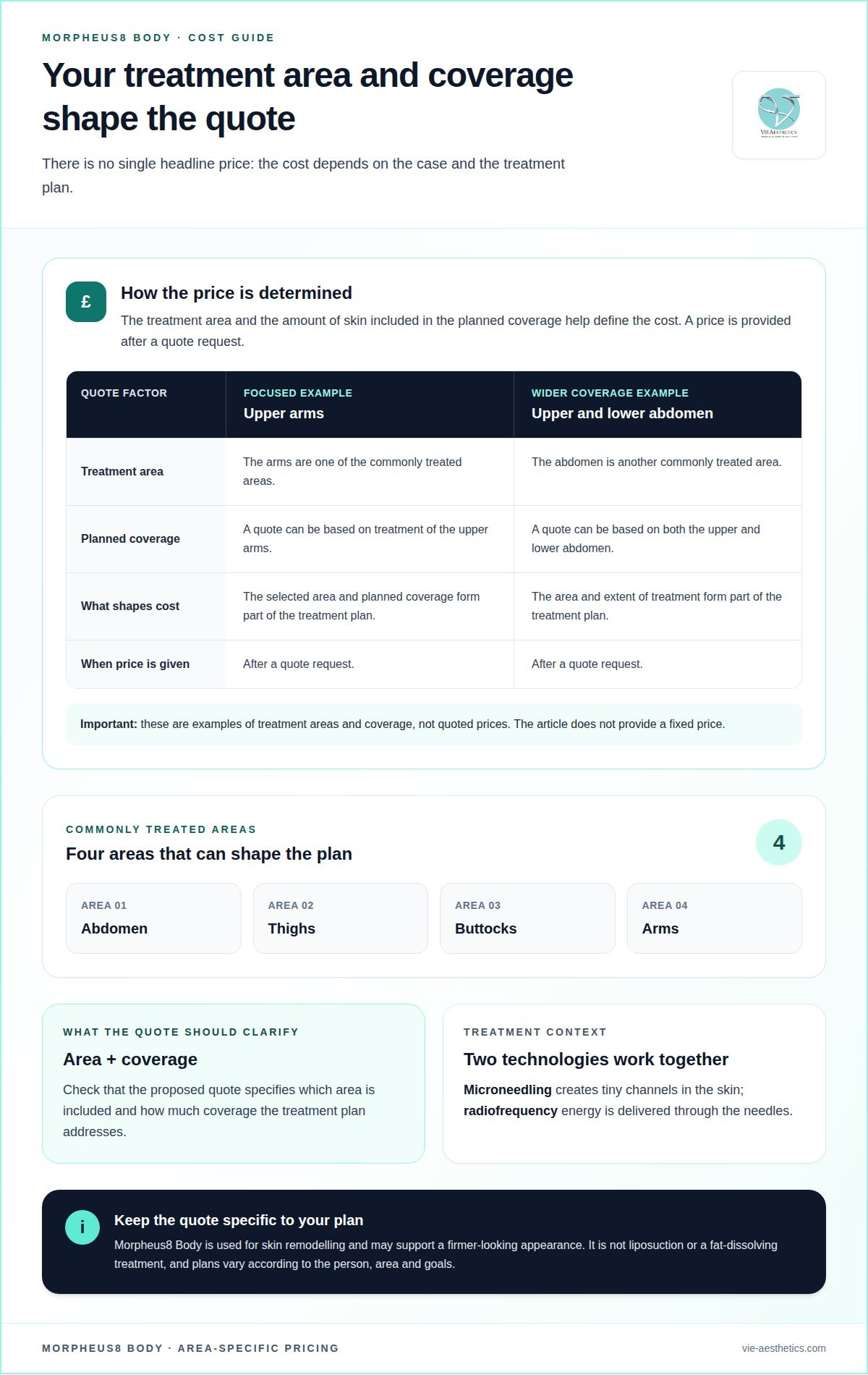
The price depends on the treatment area and planned coverage, and is provided after a quote request. Treating the upper arms differs from treating both the upper and lower abdomen because the area and extent of treatment shape the plan. A quote should specify the area and coverage included, so you can understand what the proposed treatment addresses.
Four commonly treated areas are the abdomen, thighs, buttocks and arms. The selected area helps define the plan. For example, you might be considering the abdomen rather than the arms, or a larger area rather than one specific section. The amount of skin included and planned coverage influence the cost. Clarifying your area of focus is a useful first step when discussing a quote.
To check whether a UK Morpheus8 provider is qualified and safe, ask who will perform the procedure and about their relevant training and experience. The UK Government says risks are greater when a procedure is performed by someone without sufficient knowledge or training, with unregulated products, or at unsuitable premises.
Common effects include redness, swelling or tenderness, similar to mild sunburn, and typically subside within a few days. A pre-treatment assessment should consider your health, skin and treatment area, including any circumstances that could make the procedure unsuitable.
Suitability depends on the concern you want to address and the area being considered. Morpheus8 uses microneedling and radiofrequency, so the discussion should focus on whether those treatment aims match your needs. Body contouring describes shaping the treated area; it is distinct from skin tightening, which concerns firmness. Being clear about your priority helps set a relevant goal.
Before accepting a proposed plan, make sure these details are clear:
These points show why a single figure cannot represent every treatment plan. An upper-arm appointment and a plan covering both the upper and lower abdomen involve different areas and coverage. The quote should match the plan discussed, rather than offer a general estimate that doesn’t explain what will be treated.
Use the assessment to discuss suitability and expectations before proceeding. If your priority is abdominal skin firmness, for example, describe this clearly and identify the precise area you want assessed. The resulting treatment plan and quote can reflect that focus while taking your skin and personal circumstances into account.
Morpheus8 combines microneedling with radiofrequency energy in one applicator. The needles penetrate the skin to depths of 1-5 mm, delivering energy beneath its surface.
Compared with radiofrequency microneedling, Morpheus8 Body is a specific treatment that uses both methods together. Body tightening describes a goal, while liposuction is a surgical procedure, not another form of radiofrequency microneedling.
The combination is the key distinction. Microneedling uses fine needles to reach the skin, and radiofrequency supplies energy through the applicator. In Morpheus8 Body, the two actions happen as part of the same treatment rather than as separate procedures. This matters when you want to understand what the technology does, rather than treating “tightening” as the name of a technique.
The stated needle depth is 1-5 mm. That range describes how far the applicator needles penetrate the skin; it does not mean every treatment uses one fixed depth. The chosen setting and treatment approach relate to the area being treated and the clinician’s plan. The central point is that energy is delivered through the needles at the skin depth used during the procedure.
During an appointment, a topical numbing cream is applied before the treatment to minimise discomfort. The practitioner then uses the applicator across the planned area, combining needle penetration and radiofrequency delivery. A treatment generally takes 30 to 60 minutes, depending on the area.
That sequence also helps explain how this differs from other approaches:
These options are not interchangeable. Comparing skin-focused treatment with liposuction, for example, means comparing different procedures and aims. The key question is whether the method matches the concern being discussed, not whether one name sounds more advanced. An assessment can clarify the area, intended outcome and whether this combination is appropriate.
The takeaway is straightforward: Morpheus8 Body is not simply microneedling or radiofrequency alone. It delivers radiofrequency energy through needles, combining the two technologies in a single appointment. Knowing that distinction helps you understand the treatment plan and discuss its purpose clearly.
Vie Aesthetics offers Morpheus8 for people considering non-surgical skin remodelling. If you’re weighing treatment for an area such as the abdomen or arms, a consultation can help you discuss your goals, suitability and the treatment approach. This is also an opportunity to talk through expected recovery and how results develop over time.
For body contouring goals, you can discuss whether Morpheus8, Bodyshock treatment or a combination treatment for face and body best suits your priorities. These options have different approaches, so the right conversation starts with the change you’re seeking and the area you want to address. Contact Vie Aesthetics to discuss your goals and next steps.
Deciding whether a Morpheus8 body treatment suits you starts with the change you want to prioritise. Bring a clear description of your goals to a consultation, such as improving the appearance of skin firmness or exploring a body-contouring approach. That gives the discussion a practical focus, centred on your needs rather than a treatment name alone.
Vie Aesthetics also offers Endolift Laser Treatment, Aqualyx Fat Dissolving Injections and Soft Surgery (Plexr). These are distinct treatments, and a discussion can help clarify which approach relates to your aims. The next step is an informed conversation about your priorities and the available options.
Take your time deciding. A considered plan should leave you clear about the proposed treatment and how it relates to your goals.
Take the next step when you feel ready.
Results can last up to one year or more, and results may vary between individuals. Duration depends on your personal response and treatment plan, so treat this as a guide rather than a fixed timeline. When reviewing changes months after treatment, consider how your skin looks and feels alongside your original goals. A consultation can help you understand what ongoing care may suit your circumstances.
Two sessions fall within the stated course of 1 to 3 sessions. Whether that course meets your goal depends on the area and the change you want to address. Think of the number as a treatment plan, not a guaranteed result. Progress between appointments provides useful context for discussing whether the planned course still aligns with your priorities. Results may vary between individuals.
Morpheus8 is intended for skin remodelling, not as a fat-dissolving treatment for belly fat. It may be considered for skin concerns around the abdomen, but body contouring and reducing fat are different aims. If your main priority is fat reduction, explain that clearly during an assessment so the discussion focuses on suitable options. Morpheus8 results may vary between individuals.
It may be worth considering if your priority is skin remodelling and the treatment approach matches your goals. The cost depends on the area and planned coverage, so compare the proposed plan with the concern you want to address. For instance, decide whether you’re considering one defined area or broader coverage. A clear quote helps you assess what the treatment includes before making a decision.
Early changes may appear within a few weeks, with optimal results typically observed after about three months. The most significant Morpheus8 Body results typically appear after 3 to 6 months, so allow time to assess the response rather than judging immediately. Results may vary between individuals. If you’re tracking progress, use consistent observations of the treated area and discuss them during follow-up appointments.
A suitable candidate is someone seeking skin remodelling for an area such as the abdomen, thighs, buttocks or arms. Suitability depends on your goals, health, skin and the area being considered. At an assessment, describe the change you want and any relevant health information. This helps determine whether the treatment approach fits your circumstances and supports a considered discussion of the expected treatment plan.

The treatment plan, not a single headline figure, determines what a Morpheus8 body treatment costs. For a Morpheus8 body treatment, the price depends on the case and is provided after a quote request, with the treatment area and planned coverage among the factors that shape the cost.
It’s also reasonable to want to understand what happens during treatment and how much time you may need for recovery. Morpheus8 combines microneedling, which creates tiny channels in the skin, with radiofrequency energy delivered through the needles. After treatment, redness, swelling or tenderness can occur; avoid swimming and strenuous activity for 24 hours, and makeup for at least 48 hours.
This guide explains how the two technologies work together, what can influence the cost and which aftercare restrictions to plan for. You’ll also find out what to expect from the treatment process, so you can make a considered decision about whether it suits your goals.
Key Takeaways
Allow for the listed downtime of 1-2 weeks when planning your diary. This is a planning window, not a prediction that recovery will take the same length for everyone. If you have work, travel or social plans, leave flexibility around the appointment rather than expecting the treated area to feel settled immediately.
Redness, swelling or tenderness may feel similar to mild sunburn and typically subside within a few days. Visible effects can ease before you feel ready to resume all your usual activities, so distinguish this shorter period from the stated downtime. Pay attention to your skin’s response and follow the aftercare instructions provided for your treatment.
A practical recovery plan can focus on three stages:
Pain management starts before the procedure. A topical numbing cream is applied to the skin to minimise discomfort during treatment. Factor this preparation into your appointment expectations, while keeping in mind that sensations can differ between people and treatment areas.
Follow your aftercare instructions for products and activities not covered by general guidance. Don’t add new products or procedures to the treated area without direction, and follow the advice provided for your individual treatment. This keeps your routine aligned with your care plan instead of relying on assumptions about what treated skin needs.
Choosing an appointment date is also part of aftercare planning. For example, someone with an important event may prefer to leave more space between treatment and the occasion. The 1-2-week downtime window helps with that decision, while the fact that common effects typically subside within a few days offers a separate timeframe to consider.
Safety depends on the practitioner, products and setting, as well as recovery planning. The UK Government says risks are greater when a procedure is performed by someone without sufficient knowledge or training, using unregulated products or at unsuitable premises. Consider who performs the procedure and where it takes place.
Keep your treatment instructions accessible during recovery. If you’re unsure how an instruction applies to your routine, clarify it with the practitioner responsible for your care. A clear plan makes it easier to follow advice consistently and assess your recovery based on your own experience, rather than someone else’s timeline.
Morpheus8 results develop over time as the skin responds to treatment. Understanding the reported timeline and session spacing helps you plan realistic expectations.
Changes may begin to appear within a few weeks, while the most significant Morpheus8 Body results typically appear after 3 to 6 months. The gradual timeline matters: early changes are not the same as the fuller result. Consider the treated area, the change you hope to see and how results develop across the months after treatment.
Most clients achieve their desired results with 1 to 3 sessions. Sessions are spaced 4 to 6 weeks apart, allowing time between appointments to assess progress. Results can last up to one year or more, according to the clinic’s FAQ. This describes a reported duration, not a fixed outcome for every person.
Radiofrequency energy stimulates collagen, a structural protein that supports the skin. As the skin responds after treatment, changes in firmness and texture can develop gradually rather than appearing immediately. Assessing progress over several weeks gives a fuller picture than judging your skin on the day of treatment.
For a useful discussion, distinguish skin firmness from body contour. Tightening relates to the skin’s appearance, while contour describes the shape of the treated area. Clarifying which change matters most helps define a meaningful treatment goal and assess progress against it.
Use the timeline to interpret different stages:
These timeframes describe overlapping stages, not a promise that everyone will see changes on the same schedule. The three-to-four-week point refers to more significant results appearing, while the three-to-six-month window describes the most significant body results. Collagen stimulation continues to shape the response beyond the initial weeks.
Session planning also affects how you review progress. With sessions 4 to 6 weeks apart, keep track of changes between appointments rather than judging the full course after one visit. A plan may include 1 to 3 sessions, depending on the desired outcome. A body skin assessment can help you discuss suitable goals and timing.
The price depends on the treatment area and planned coverage, and is provided after a quote request. Treating the upper arms differs from treating both the upper and lower abdomen because the area and extent of treatment shape the plan. A quote should specify the area and coverage included, so you can understand what the proposed treatment addresses.
Four commonly treated areas are the abdomen, thighs, buttocks and arms. The selected area helps define the plan. For example, you might be considering the abdomen rather than the arms, or a larger area rather than one specific section. The amount of skin included and planned coverage influence the cost. Clarifying your area of focus is a useful first step when discussing a quote.
To check whether a UK Morpheus8 provider is qualified and safe, ask who will perform the procedure and about their relevant training and experience. The UK Government says risks are greater when a procedure is performed by someone without sufficient knowledge or training, with unregulated products, or at unsuitable premises.
Common effects include redness, swelling or tenderness, similar to mild sunburn, and typically subside within a few days. A pre-treatment assessment should consider your health, skin and treatment area, including any circumstances that could make the procedure unsuitable.
Suitability depends on the concern you want to address and the area being considered. Morpheus8 uses microneedling and radiofrequency, so the discussion should focus on whether those treatment aims match your needs. Body contouring describes shaping the treated area; it is distinct from skin tightening, which concerns firmness. Being clear about your priority helps set a relevant goal.
Before accepting a proposed plan, make sure these details are clear:
These points show why a single figure cannot represent every treatment plan. An upper-arm appointment and a plan covering both the upper and lower abdomen involve different areas and coverage. The quote should match the plan discussed, rather than offer a general estimate that doesn’t explain what will be treated.
Use the assessment to discuss suitability and expectations before proceeding. If your priority is abdominal skin firmness, for example, describe this clearly and identify the precise area you want assessed. The resulting treatment plan and quote can reflect that focus while taking your skin and personal circumstances into account.
Morpheus8 combines microneedling with radiofrequency energy in one applicator. The needles penetrate the skin to depths of 1-5 mm, delivering energy beneath its surface.
Compared with radiofrequency microneedling, Morpheus8 Body is a specific treatment that uses both methods together. Body tightening describes a goal, while liposuction is a surgical procedure, not another form of radiofrequency microneedling.
The combination is the key distinction. Microneedling uses fine needles to reach the skin, and radiofrequency supplies energy through the applicator. In Morpheus8 Body, the two actions happen as part of the same treatment rather than as separate procedures. This matters when you want to understand what the technology does, rather than treating “tightening” as the name of a technique.
The stated needle depth is 1-5 mm. That range describes how far the applicator needles penetrate the skin; it does not mean every treatment uses one fixed depth. The chosen setting and treatment approach relate to the area being treated and the clinician’s plan. The central point is that energy is delivered through the needles at the skin depth used during the procedure.
During an appointment, a topical numbing cream is applied before the treatment to minimise discomfort. The practitioner then uses the applicator across the planned area, combining needle penetration and radiofrequency delivery. A treatment generally takes 30 to 60 minutes, depending on the area.
That sequence also helps explain how this differs from other approaches:
These options are not interchangeable. Comparing skin-focused treatment with liposuction, for example, means comparing different procedures and aims. The key question is whether the method matches the concern being discussed, not whether one name sounds more advanced. An assessment can clarify the area, intended outcome and whether this combination is appropriate.
The takeaway is straightforward: Morpheus8 Body is not simply microneedling or radiofrequency alone. It delivers radiofrequency energy through needles, combining the two technologies in a single appointment. Knowing that distinction helps you understand the treatment plan and discuss its purpose clearly.
Vie Aesthetics offers Morpheus8 for people considering non-surgical skin remodelling. If you’re weighing treatment for an area such as the abdomen or arms, a consultation can help you discuss your goals, suitability and the treatment approach. This is also an opportunity to talk through expected recovery and how results develop over time.
For body contouring goals, you can discuss whether Morpheus8, Bodyshock treatment or a combination treatment for face and body best suits your priorities. These options have different approaches, so the right conversation starts with the change you’re seeking and the area you want to address. Contact Vie Aesthetics to discuss your goals and next steps.
Deciding whether a Morpheus8 body treatment suits you starts with the change you want to prioritise. Bring a clear description of your goals to a consultation, such as improving the appearance of skin firmness or exploring a body-contouring approach. That gives the discussion a practical focus, centred on your needs rather than a treatment name alone.
Vie Aesthetics also offers Endolift Laser Treatment, Aqualyx Fat Dissolving Injections and Soft Surgery (Plexr). These are distinct treatments, and a discussion can help clarify which approach relates to your aims. The next step is an informed conversation about your priorities and the available options.
Take your time deciding. A considered plan should leave you clear about the proposed treatment and how it relates to your goals.
Take the next step when you feel ready.
Results can last up to one year or more, and results may vary between individuals. Duration depends on your personal response and treatment plan, so treat this as a guide rather than a fixed timeline. When reviewing changes months after treatment, consider how your skin looks and feels alongside your original goals. A consultation can help you understand what ongoing care may suit your circumstances.
Two sessions fall within the stated course of 1 to 3 sessions. Whether that course meets your goal depends on the area and the change you want to address. Think of the number as a treatment plan, not a guaranteed result. Progress between appointments provides useful context for discussing whether the planned course still aligns with your priorities. Results may vary between individuals.
Morpheus8 is intended for skin remodelling, not as a fat-dissolving treatment for belly fat. It may be considered for skin concerns around the abdomen, but body contouring and reducing fat are different aims. If your main priority is fat reduction, explain that clearly during an assessment so the discussion focuses on suitable options. Morpheus8 results may vary between individuals.
It may be worth considering if your priority is skin remodelling and the treatment approach matches your goals. The cost depends on the area and planned coverage, so compare the proposed plan with the concern you want to address. For instance, decide whether you’re considering one defined area or broader coverage. A clear quote helps you assess what the treatment includes before making a decision.
Early changes may appear within a few weeks, with optimal results typically observed after about three months. The most significant Morpheus8 Body results typically appear after 3 to 6 months, so allow time to assess the response rather than judging immediately. Results may vary between individuals. If you’re tracking progress, use consistent observations of the treated area and discuss them during follow-up appointments.
A suitable candidate is someone seeking skin remodelling for an area such as the abdomen, thighs, buttocks or arms. Suitability depends on your goals, health, skin and the area being considered. At an assessment, describe the change you want and any relevant health information. This helps determine whether the treatment approach fits your circumstances and supports a considered discussion of the expected treatment plan.